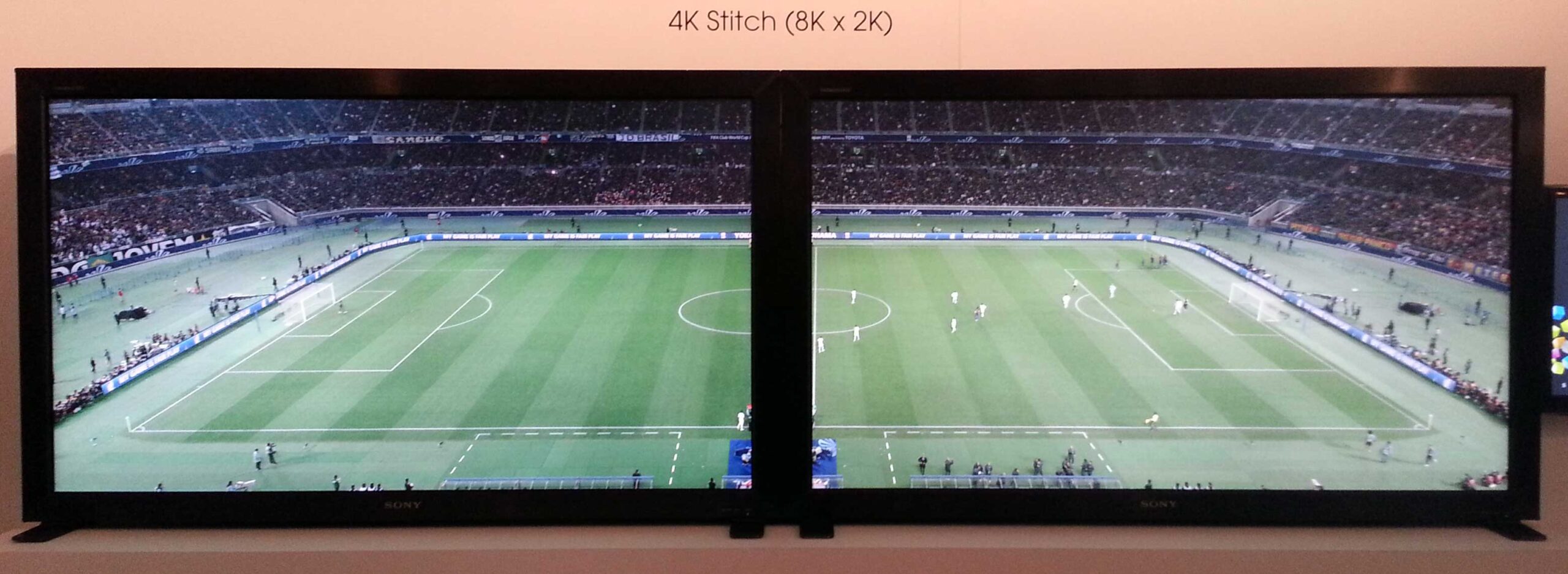
 Display technologies are constantly evolving. With the trend to "Retina" displays with high resolution DPI, it seems to be natural for traditional broadcast TVs to do the same.
Some technology companies, specifically Sony (pictures above and right), showed some amazing 4k television technology at IBC 2012 in Amsterdam. The image quality set another standard for high quality, close to reality, video playback in the living room.
[iframe width="570" height="321" src="http://www.youtube.com/embed/SFmXVEmIJ8I" frameborder="0" allowfullscreen /]
The resolution is truly amazing. But how do you deliver video to screens that large? HEVC seems to be one of the potential answers.
High Efficiency Video Coding (HEVC), also unofficially called H.265, H.NGVC, and MPEG-H Part 2, is a draft video compression standard. HEVC is a successor to H.264/MPEG-4 AVC (Advanced Video Coding) and is currently under joint development by the ISO/IEC Moving Picture Experts Group (MPEG) and ITU-T Video Coding Experts Group (VCEG). MPEG and VCEG have established a Joint Collaborative Team on Video Coding (JCT-VC) to develop the HEVC standard. HEVC is said to improve video quality, double the data compression ratio compared to H.264, and can support resolutions up to 7680 × 4320. [more details on Wikipedia]
Exciting technology - maybe we'll see 4k televisions with high quality, glasses-free 3d projection soon.
ARCHIVE NOTE
This article was originally published on overdigital.net and has been migrated to overdigital.ai as part of our content archive. Some links or embeds may no longer work.
Browse more archived articles